Tuesday, April 22, 2014

more keyboard stuff...

Here's the wood I've purchased for the keyboard and action parts.  All bound up in a bundle, to try to keep stuff from warping too much.  Basswood: pretty light wood, easy to machine, similar to balsa but in fact much denser than that.  Several different dimensions (all 24" long), for the strikers and such; the keylevers themselves will be 3/8" x 3/16", and 12" long.  Which is quite thin, I hope they are strong enough, especially after the several necessary holes are drilled through or into various places on these thin strips of wood.  The intent is severalfold.  For one, I hope that the thin and light levers will have low mass and low inertia, so that as much as possible of the acceleration work done to the key by the finger, is transferred to the strikers, which the keylevers fling (*) into collision with the strings.  The strikers are basswood too, but they are of thicker dimensions, and they are necessarily pretty long to clear the wrestplank (about 3" long), so they've got some mass.  I think I will probably "size" the strikers with Titebond glue, to try to prevent splitting; if they split anyway, or wear down quickly, or otherwise fail to cut it, I may have to try other, harder, woods for this.

Here I've started laying out the hole-markings for a set of four prototype keylevers, which I will construct to test out my ideas before committing to the full 49-key keyboard.  Among many important parameters to verify, the most important is the "fulcrum point", i.e., where to drill the hole that a thick steel wire will pass through, forming the pivot point of the key-lever.  If it were right in the middle, the key would be approximately balanced, and the motion ratio of striker to key would be about 1:1.  However, I want a higher motion ratio, and I want the keys to have a positive gravity return, so the fulcrum will be located closer to the keys (i.e., the front end).

After all the complicated motions in the action of a modern piano, the effective motion ratio (as near as I can tell in my readings) usually works out to be around 5:1.  So I take this as my upper practical limit, and I figure that I'll probably get some kind of satisfactory operation at lower ratios, too.  Initially, I was planning to try about a 3:1 ratio first.  But when I started laying out the keys, having already started to develop some intuitive sense for how they might operate, I just said what the heck and went for a higher ratio: my fulcrum point is at the 2" position from the front end of the 12" keylever, which would indeed imply a 5:1 ratio.  In actuality, the ratio will be lower because the key surfaces extend more than another inch beyond the end of the lever, and also the striker is located an inch away from the back end of the lever, i.e., at the 11" position.  (I measure all the distances from the front ends, to nullify inaccuracies both in the original nominal 24" length, and in my cutting down to 12", which can be up to 1mm or so, it seems.)

...Meanwhile, I've continued experimenting with arcade-cutters.  My first one was promising, but it cut a little bit rough and also I thought the profile of the arcades produced was too deep.  So I made a second one, with a shallower cutting slope.  I had figured to file the cut edge to make it sharper, but actually the way I happened to position it when initially clipping the "ears" off with my mega-bolt-cutters, left a nice sawtooth bevel to the edge, facing the right way to cut in the direction of rotation.  I guess the first time, this bevel ended up facing the opposite way.  So, I just used my smaller tinsnips to put a few nicks of different depths into the sloped cutting edge, to produce the curved arcades.

Here I go, cutting this new arcade pattern into a poplar 1x2.  I'll dice them up later: a little rectangle of wood containing only the top half of the circular pattern, will go on the front of each natural key.

Here, you can see the trapezoidal profile of my cutter, in the drill chuck.  The almost-horizontal sloped edge is the cutting edge.

...And here are my four prototype keylevers, taking shape.  Now I have drilled the 1/16" holes and threaded them onto #16 steel wire, which through no coincidence happens to be a nice tight fit.  I "ease" the fit by bending the keylevers back and forth, but *not* up and down, thus giving enough looseness to pivot freely on the wire, without sacrificing the wire's ability to prevent the keylever from rocking back and forth on its long axis: which would cause the top ends of the strikers to move back and forth and interfere with each other.  If the strikers still have too much side-to-side motion, I'll have to run them through a guide, but I'd like to minimize such sources of friction, especially in the region where motion will be 5x accelerated.  (Side-to-side angling of the keylevers is not a problem, because they will be passing through guides, consisting of vertical "combs" of shiny nails, which constrain this motion.)

The brass eyehook thingies on the tops of the levers are for adjusting the damper heights.  The dampers will come from underneath, just like the strikers, and they will be held in position by (globally adjustable) spring force.  When a key is pressed down, it pulls upward on a pair of nylon monofilament ("fishing line") cords, which pass across two "pulleys" (possibly not moving parts, just smooth metal wire for low friction) and then pull the damper downward, against spring force.  The monofilament attaches to the keylever via another drilled hole, which is located close to the fulcrum (1" away in the present design).  Thus, the motion of the damper is at a low motion ratio, not the 5x of the striker.  This reduces the spring force felt at the key, relative to how much is needed to be effective at the damper location.  And it prevents unnecessary acceleration and travel of the dampers, which only need to move a fraction of the distance covered by the striker.  And finally, it allows the dampers to come-from-beneath, which enables the entire action unit to be removed easily for service and adjustment: especially important given that my keylevers and "jacks" (strikers) are not separately-removable "in vitro", as they would be in a conventional harpsichord.

...So anyway, the eyehooks enable the monofilament to be "reeled in", thus setting the height of the dampers (or more precisely, they set the point in keytravel at which the dampers start to move and un-damp the string, which will critically affect the nature and feel of the articulation).

Just playing upon the raw keylevers like this, with my fingers, I can tell that the high motion ratio is good, I like how fast it makes the striker ends move, yet the levers are light enough that it doesn't feel like a harsh task to set them in motion, despite the leverage.  I can play trills and repeats without lags or stutters.  These levers are, by design, much more similar to the long, thin hammers that would be used with a hammer-dulcimer, than to anything you'd find under the hood of a piano.

Tuesday, April 8, 2014

starting on the keyboard

The frame (or "harp") has been under string tension for a couple months now, without doing anything terrible.  I have started to assemble the necessary materials to build the keyboard and action.

I found these great glass-covered tiles, the white rectangles in the pic, which will I think be perfect for the sharps.  I was considering using the black square tiles you see, for the fronts of the naturals (and plain black wood for the rest).  But the black tiles are slightly too wide.  I'd have to grind them down on two sides, to make them fit in the necessary spacing without touching.  Before I get into ceramic-grinding, I'd rather find something that fits off-the-shelf.  Or, make something...

Here you can see the little thumbscrew thingie which I have turned into an arcade-cutter.

And here it is again, after clipping its wings off asymmetrically, and scoring the wider-angle side so that it cuts a nice pattern of grooves.  This will be used to cut "arcades" in the front edges of the keys: another small bit of decoration which I allow myself, on this essentially ugly-but-functional prototype instrument.  (Partly, of course, I am just developing the decoration techniques for later use, and this instrument is the guinea pig.)

Here is the plywood jig I have made, for rolling out flat slabs of clay at a consistent thickness.

Only Duck Pond 2002 Chardonnay bottles will work for this, they are made of a special glass which resonates with the molecular structure of the...

A nice slab of clay, rolled out and ready to become an octave of natural keys.  This is "Della Robbia" oven-bake clay.  After air-drying for a week or so, you bake it in the oven at low heat (like 200F), and hopefully it ends up hard enough to be the covering of natural keys!  Or not...

I used laser-printed templates, both to initially cut the key shapes (I used a matte knife), and then later to trim the partially-dried keys to final shape and size, by comparing with the lines on the template underneath.

Here's the first of the four octaves, trimmed and ready to dry for a few days.  The other three are waiting for trimming in the background...

...However, since it was then time for me to go attend to other aspects of life, I stored the other untrimmed octaves in plastic containers, with moist paper towels in there.  I hope this keeps them pliable until I get back to them (within a day).  Looks like a big batch of yummy fudge!

Friday, January 24, 2014

pickups

Now that I hear that the tone is going to be good, I start to proceed with a number of other tangents which were effectively waiting to see if it passed the first test.  One of these, is design of the pickups.  The whole reason I have used the strings that I have, i.e., iron throughout, no brass, is so that I can use an electromagnetic pickup with this instrument.  Which may not even sound good, it's an experimental idea.  (Possibly, "acoustic guitar" style piezo pickups would capture a more natural image of the sound; however, I want (or think I want) that "electric guitar" sound.  Perhaps both types of pickups will be useful.)

I took a first concrete step: ordered a 1/2 pound roll (2430 feet) of 32-guage magnet wire, from All Electronics (.com).  I will have to experiment with magnets and pole-pieces (nails or screws?), and see if I can come up with an easy-to-execute design.  I'll probably build some kind of jig to help me wind the coils; whether there will be a coil-per-note, or longer "rectangular" coils around groups of polepieces, like in some guitar pickups: I don't know.  And initially, I was picturing making something akin to a really wide single-coil guitar pickup, regardless of the number of coils.  But I suspect a "humbucker" would make a lot more sense, since guitars with single-coil pickups are already invariably a hum problem, and this will have 10 times the "antenna" size.  Getting a *usable* signal may be quite a challenge.


stringing completed


Well, I now have all the strings in place, 49 pairs.  No sign of trouble from the frame under this tension, so far...  Of course, this is the minimum tension that I might want it to handle: I've started out tuned to "C", i.e., two whole steps below the max pitch ("E").  I have to decide if I really want to stick with this rather extreme under-tuning, or whether I want to move up to, say, at least "D".  But I don't mind breaking-in the instrument on the low pitch, anyway.  (Don't really like that word, "break"...)

You can see that I placed felt "bowties" at the hitching points of the strings.  These are to mute the "Aliquot" effect, the (dissonant) ringing of the short ends of the strings, which are not supposed to be part of the "speaking length".  I hope that this "bowtie" design will hold up over time.  The rectangles of felt are stuffed in between the pairs of strings, kept in place by a hole in one end of the felt which goes over the hitch-pin.  Thus, even as the felt ages and shrinks, there should still be excess pressure keeping material pressed against the strings.  As opposed to the common technique of lacing a long ribbon over and under, through the strings: over time the loops of ribbon tend to sag away from the strings, leaving some un-muted.

(I haven't done anything (so far?) about the even-shorter lengths between the nut and the tuning pins.  These aren't as close to some of the real notes, as the other segments were, and plus I'm more concerned about the segments that are in contact with the bridge and soundboard.)

Now I can start to get a sense of the overall tone that the instrument will have, the balance of the lows and the highs, etc..  I'd say, so far, that I love the tone of the basses and I'm very excited to use those tones, they are exactly what my music is wanting.  The middle range is also excellent, very woody and cello-like, lots of resonance.  I think I made the larger of the two sound holes, too large.  I will have to experiment with different reducing baffles over it, before I build another one of these.  The voicing of the "vowels" in the midrange, is too "open", I wanted more nasal.  But it's acoustically impressive; I expected that nasalness would be easy to attain, but loud round resonance might be lacking, but it's almost the opposite.

The treble, however, does not please me that much, so far.  Maybe it's just because the tuning is so far off, the noises are always off-pitch caterwauling horror-movie sounds.  But even so, I can still tell that the bass and mid sound good.  The treble is too fluty, too plain, too much sounding like the strings are too short and too thick.  Maybe this is the area where there is a detrimental effect to the two-step under-tuning.  Maybe it will improve when I can access these notes with a real keyboard, and when they have articulating dampers.  But then again, maybe "treble that please me" will turn out to be an ongoing quest.

(Another of the many possibilities for why the treble doesn't satisfy, which I should certainly acknowledge, is that maybe this is a result -- the "cost" -- of having too thick, or too absorbent, of a soundboard.  My Home Depot plywood soundboard seems to work amazingly well for the bass and midrange, but maybe the treble is where a thinner, solid-wood, soundboard would show its difference.  Since others will surely speculate thus, let me do so as well!  Has some acoustic basis...  Or maybe a million things about the bracing, etc., etc....)

Now begins the long process of gradually bringing her into tune.  Unsurprisingly, the tuning of the existing strings was sagging about a whole step per day, as I gradually added more strings over this past week.  I expect and certainly hope to see this gradually stabilize, now that all the tension is applied.  If not -- I can cover it with glass and it'll make a really unique coffee table!


Monday, January 20, 2014

beginning the stringing process

Drilling the holes in the wrestplank out to the final 3/16".  As you can see, I used a piece of duck tape with a hole in it, to try to minimize wood shavings falling down into the holes.  The drilling went quite smoothly; the guide holes worked such that there was no ambiguity as to the angle of the drill, and hitting bottom of the guide hole was quite clear, there was no danger of wandering deeper with the 3/16" drill.  So I think all the holes ended up quite consistent, in the positions which were determined by the drill press.

Hammering in the hitch-pins (just slightly-tougher nails).  I placed them by-eye, not so much for consistent appearance but so as to meet the condition that all the strings have between 10 and 20 degrees of side-bearing, centered around the average of 15 degrees.  So they look kind of haphazard, but each one is, I think, in the (a) correct position.  The haphazard appearance is in a way intentional: I want to emphasize that high precision is not needed here.  Nailing into my nice, wide 2x4 "hitch rail" has plenty of room for error.  The design removes a requirement for exactitude here.

Using one of my little cardboard guides, to make sure all the hitch-pins are hammered in to the same height.

Stringing up this instrument, so far, has been a breeze, as I hoped and planned.  The "double stringing" (i.e., two strings from each hitch-pin) means that I don't have the tedious job of making a twisted loop at the end of each string.  Instead, the procedure is, tape down one end of the string at the wrest-plank, allowing enough extra length to wind around the tuning pin several times.

Then run this wire up, over the bridge, around the hitch-pin, and back over the bridge and back to the wrestplank, forming a parallel pair of strings.  A piece of duck tape on the nut holds both wire ends in place, so that the wire can be cut (just like I do with guitar strings, I grip with needle-nose pliers and bend the wire back and forth a few times, causing it to break from the stress; this is easier and causes less wear to my tools, than actually cutting the wire).

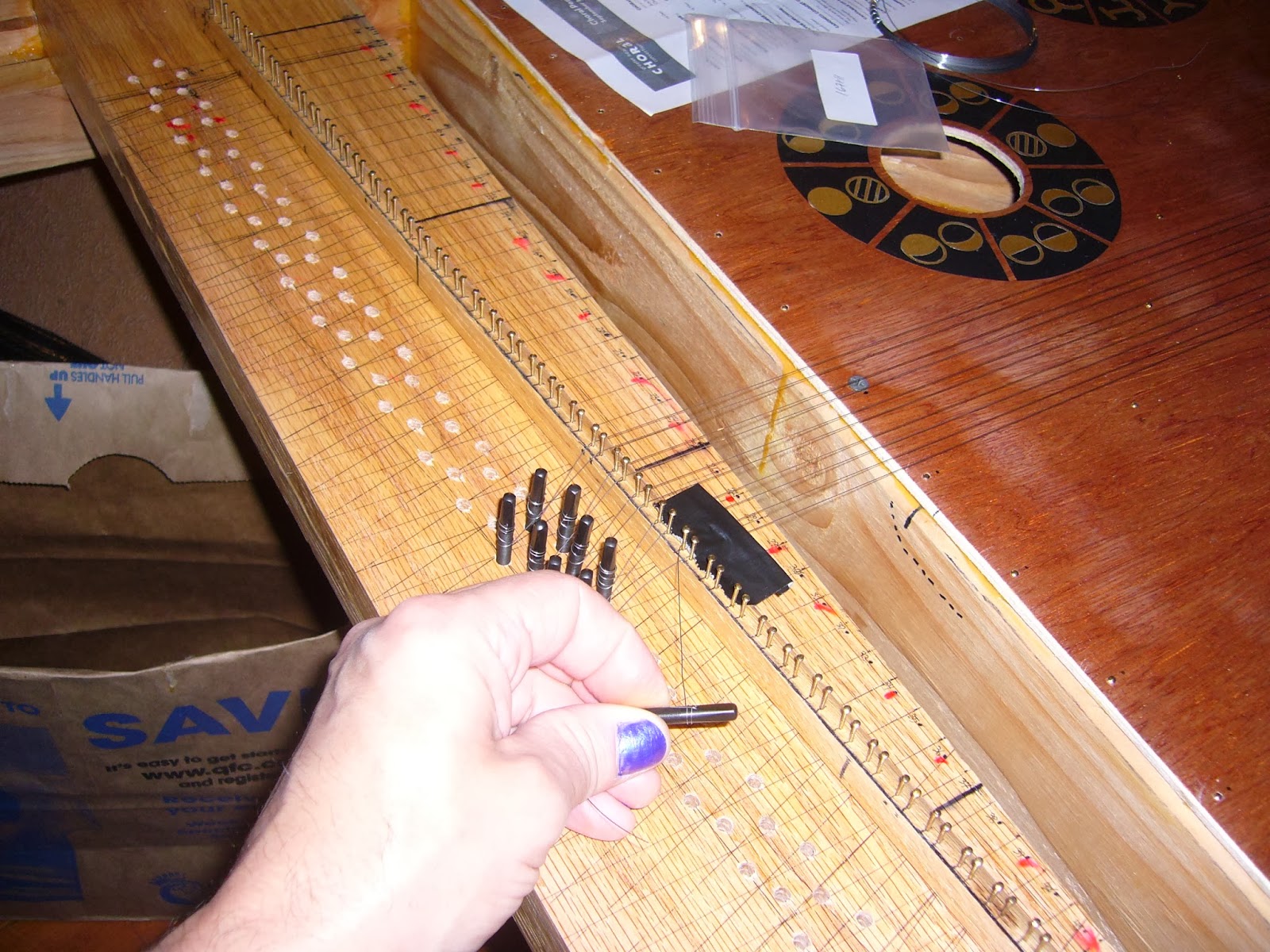
I wind the extra wire length onto the tuning pin, holding the pin in my hand, before it is inserted into the wrestplank.  The first couple windings go over the bent end of the wire, pinning it down tightly against the side of the tuning pin.  Then I angle the windings downward so that the final windings come off near the bottom of the pin (i.e., near the bottom of the portion which will be exposed after hammering it in, which is more towards the middle of the overall pin), to give an adequate amound of down-bearing force at the nut.  (For the tuning pins which are closer to the nut, I end the windings higher up on the pin, so that the down-bearing angle is approximately the same for each string in the pair.)  Once the wire is wound up on the pin snugly, I fit the end of the pin into its wrestplank hole, and pound it in with about 10 blows from my small hammer.  I.e., nothing subtle here, the pins are pounded in pretty good.  The oak works just fine as a wrestplank, as far as I can tell.  There is plenty of friction, no tendency for pins to slip, yet the tuning is easy and smooth, I don't seem to find places where it jumps from too-low to too-high and such.


I'm up to 17 notes now, or 34 strings: just about one third of the total tension.  No horrible cracking noises yet!


Thursday, January 16, 2014

sealed!

OK, the soundboard is glued in.  No turning back now!

I put the instrument up on its spine side, to blow the dust out of its soundbox cavities, before covering them over for good.

There were 16 "decorative" nails to be placed, marking the positions of the soundboard braces.  I did these while the soundboard was still unattached, so that I could hammer into the braces while they were resting against the floor.  I drilled down to a depth of 1/2" using a drill spacer as you can see, then hammered the 3/4"-long nails in the rest of the way: which caused them to very slightly break through the bottom surfaces of the braces.  So the pre-drilling to avoid splitting was probably especially important.

My fine little jewelry hammer has been just right for all the hammering jobs in this project so far.  Putting in the tougher steel hitch-pins may wreck it for any future jewelry career, however.

Last chance to see inside.  Here's the glue-bead, waiting for me to place the soundboard on top and then hammer in the 106 "structural" nails...

...Which took quite a while, most of an hour; so I was glad that the Titebond II tends to stay workable for that long, especially in low-air regions where copious amounts have been used, as here.


122 nails, total.  And then there will be 49 hitch-pin nails.  And there are 196 nails already, between bridge-blocks and the nut.  That's approximately... a lot!

Wednesday, January 15, 2014

lotsa nails...

Almost, almost ready to glue this soundboard down.  You can see that I sanded away the polyu finish which I had failed to tape-mask for, on the underside of the soundboard where it meets the main diagonal brace, in between the two sound holes.


And I hammered-in some large number of 3/4" #18 brass-plated nails (same as I used for the bridge and nut pins -- the hitch-pins, however, will need to be a different type of nail).  Just far enough to get them started, so that I can quickly drive them home once I glue the soundboard down.

"The Instrument is the Go-Deck."